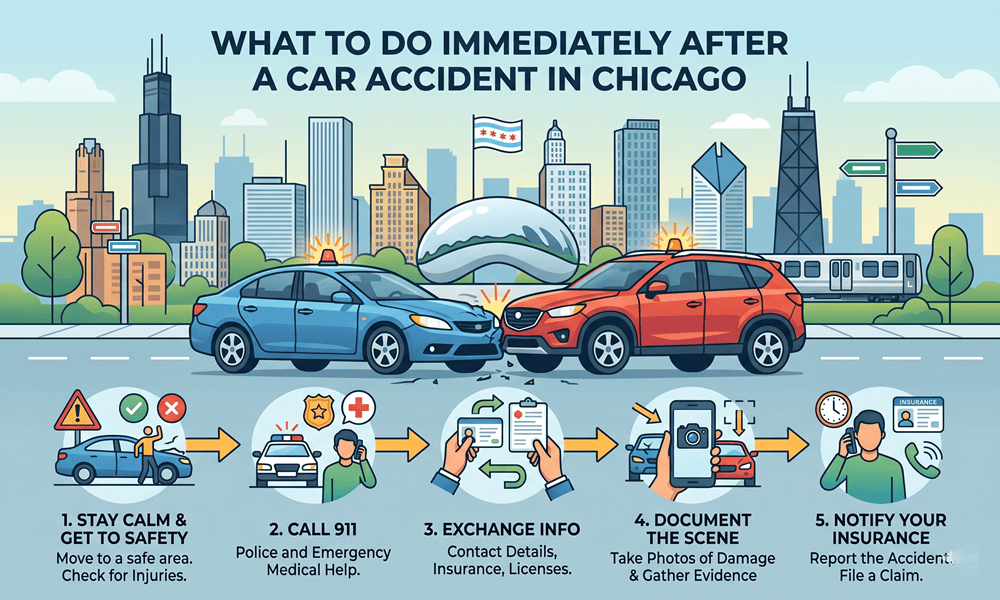
The moments immediately following a car accident are disorienting. Adrenaline is high, the situation is unfamiliar, and the decisions you make in that window, or fail to make, can have consequences that extend far beyond the scene itself. In Illinois, what you do and document in the immediate aftermath of a collision has a direct bearing on your ability to pursue compensation for injuries, vehicle damage, and other losses.
This guide covers the steps in order of priority so that if you ever find yourself in that situation, you have a clear framework to follow rather than having to work it out under stress.
Step One: Check for Injuries and Call 911
Before anything else, assess whether anyone involved in the accident is injured. Do not move anyone who appears to have a neck or back injury unless there is an immediate danger such as fire. Call 911 regardless of whether injuries are apparent. In Chicago, a police report is an important piece of documentation for any subsequent insurance claim or legal action, and having officers attend the scene creates an official record that is far more reliable than the accounts of the parties involved.
If you are injured, say so clearly to emergency responders. Do not minimise your symptoms in the moment. Many injuries, including whiplash, soft tissue damage, and concussions, do not present with obvious pain immediately after a collision. Adrenaline masks pain effectively, and symptoms that feel minor at the scene can become significantly more pronounced within 24 to 72 hours.
Step Two: Stay at the Scene and Exchange Information
Illinois law requires drivers involved in an accident to remain at the scene until they have exchanged information and, if required, until law enforcement has attended. Leaving the scene of an accident that involves injury is a criminal offence. Stay calm, move vehicles out of active traffic if it is safe to do so, and exchange the following with every other driver involved: full name and contact details, driver’s licence number, vehicle registration, and insurance policy information including the provider name and policy number.
Do not discuss fault at the scene. Do not apologise, even as a social reflex, because statements made at the scene can be used against you in subsequent proceedings. If the other party becomes aggressive or attempts to negotiate a private settlement without involving insurance, decline. Protecting your legal position starts at the scene. If you are unsure of your rights in the immediate aftermath, Chicago personal injury attorneys offer free case evaluations and can clarify what your situation requires before you make any decisions that affect a potential claim.
Step Three: Document Everything You Can
If you are physically able, use your phone to document the scene thoroughly before vehicles are moved or the environment changes. Photograph every vehicle involved from multiple angles, capturing the damage, the licence plates, and the positions of the vehicles relative to each other and to road features such as intersections, traffic signals, and lane markings. Photograph any visible injuries on yourself or other parties. Photograph road conditions, skid marks, debris, and any environmental factors such as obscured signage or poor lighting that may be relevant.
If there are witnesses, ask for their names and contact details. Witness accounts from independent parties carry significant weight in disputed liability situations, and witnesses leave quickly once the immediate situation resolves. Getting their information while they are still present can make a material difference to a subsequent claim.
Step Four: Seek Medical Attention Promptly
Go to an emergency room or urgent care facility after the accident, even if you feel relatively uninjured. A medical evaluation on the day of the accident creates a contemporaneous record linking any injuries to the collision. Waiting several days to seek treatment gives insurance adjusters grounds to argue that your injuries were not caused by the accident or that they are less serious than claimed.
Follow all medical advice after your initial visit. Attend follow-up appointments, complete prescribed treatment, and keep records of every medical interaction, prescription, and expense related to the accident. These records form the foundation of any compensation claim for medical costs and ongoing care.
Step Five: Notify Your Insurance Company
Report the accident to your own insurance company promptly, as most policies include notification requirements with specific timeframes. Be factual and accurate in your account but avoid speculation about fault, accepting blame, or making definitive statements about the extent of your injuries before you have a complete medical picture. You are not required to provide a recorded statement to the other driver’s insurer, and it is generally advisable to speak with a lawyer before doing so.
Insurance companies are businesses that manage claim costs. Their adjusters are experienced at minimising payouts, and initial settlement offers following an accident frequently undervalue the full extent of losses, particularly where ongoing medical treatment, lost income, or long-term consequences are involved.
If you have been injured in a collision in the Chicago area and want to understand what your claim may be worth and how to pursue it effectively, speaking with a Chicago car accident lawyer as early as possible in the process gives you the clearest picture of your options and the best position from which to negotiate with insurance or pursue legal action.




 Effective Law
Leave a comment